Taylor’s Plot at Santa Rosa Rural Cemetery

Last Saturday, I met with some local artists to tour and sketch Santa Rosa’s Rural Cemetery. The name Rural Cemetery is a kind of a misnomer because if it were located any closer to town, it would be downtown. The cemetery is situated on a small hill covered with live oak and eucalyptus trees that, in the evening, cast long, dark shadows across the grave sites.

Our knowledgeable and funny tour guide, Ray Owen, has written two booklets on the history of the cemetery and easily answered our questions. Since the cemetery’s founding in 1854, many locally well-known people have been buried there, including Winfield S. M. Wright who died in 1892. Wright’s Beach, Wright Road and Wright School were all named after him. Sarah Wright, his wife, was the granddaughter of the famous American explorer and folk hero Daniel Boone. James Armstrong’s grave is on the south side of the cemetery. He’s best known for donating 490 acres of old growth redwood that later became the beautiful Armstrong Woods State Preserve.

For about an hour, Ray led us around the cemetery telling stories, some funny, some sad. But once we reached the top of the hill, he showed us the most visually interesting grave in the cemetery, the Taylor plot. Over the years, an oak tree rested on the grave stone for support for so long that it grew into the stone monument. This is where I chose to park myself for about an hour to sketch and watercolor.

On September 16 and 17 (2011) there will be Lamplight Tours from 7:30pm through 9:50pm, when visitors can walk through the cemetery at night and hear dramatic portrayals of some of Santa Rosa’s early settlers. No doubt ghost stories will be on the agenda!

For more information on the cemetery and Lamplight Tours, click here: http://bit.ly/l9MizH


***UPDATE***

Taylor’s Plot tree fell this wast weekend 04/06/13. It’ll probably have to be removed from the cemetery.

The Press Democrat Newspaper has the story.
Diverging Paths

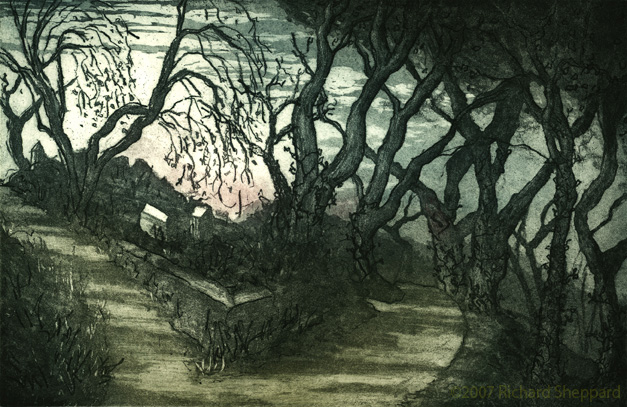
Last Saturday wasn’t the only time I’ve sketched at the Santa Rosa Rural Cemetery. Several years ago I created a soft ground etching of two diverging pathways as they snake their way along the hillside. Creating etchings plein-air is surprisingly easy with some planning. I prepared all my materials before hand, including my metal plate and acid bath.

When I arrived at the cemetery, I spend a good half hour walking around admiring the beauty of the twisted oak trees and the paths that weave through them. After finding a good place to sketch, I sat at the path’s edge and sketched directly on a piece of paper covering a soft ground etching plate. With the pressure of my conté crayon on the paper, my sketch was transferred through the ground to the plate below. Once the drawing was finished, I removed the paper and put the plate directly into an acid bath I had prepared in a plastic container. After a few minutes, the acid etched my drawing into the plate, creating indentations into the metal that ink would stick to when printed.

The Santa Rosa Rural Cemetery is a beautiful and peaceful place, almost park-like. My etching, Diverging Paths, shows the afternoon sun casting lengthy shadows across the paths and grave sites. I feel as though I’ve adopted this area as a place to visit my mom who died a few years ago. Since her ashes were spread in the desert botanical gardens of Arizona, I don’t have a local place to visit her. My mom loved the morning sunshine and I like to think of her resting among the violet colored sweet-pea flowers that populate this hillside.

Jazz in the Afternoon

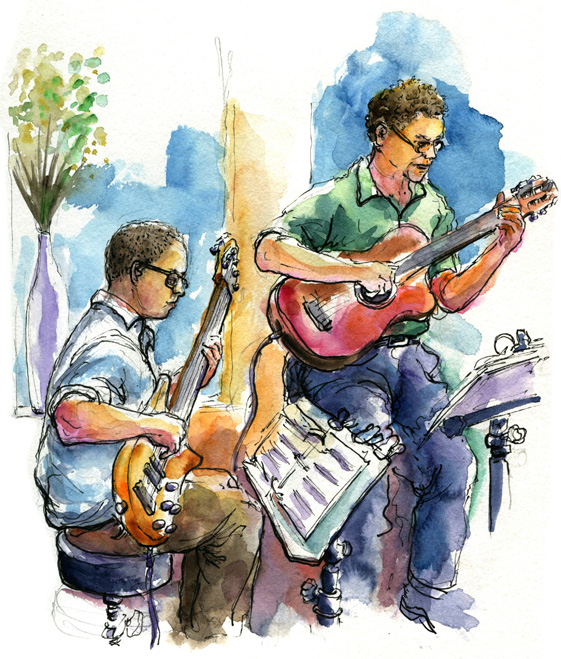
It was a hot summer day in Healdsburg when my wife Marilyn and I walked over to Affronti for brunch. This semi-hidden restaurant is located down a long corridor beside La Crema Winery’s tasting room, just south of the Plaza. Today the Christian Foley Jazz Duo was scheduled to perform and I’ve wanted to hear them play for some time.

When we arrived, the band was setting up in the corner and Marilyn went over to say hello to her friend Roz, whose husband Todd Smith plays bass in the duo. Together, the three of us sat down at a table and ordered some food. While sipping iced tea to keep cool, I pulled out my sketch pad and drew the musicians as they launched into an exclusive Pat Metheny set starting with the song, “Spring Ain’t Here.”

Christian Foley played acoustic and electric guitars, and used pedals to change the guitar’s sound to mimic a steel drum and other instruments. During a break between sets, I asked Todd about his unusual looking bass. He described it as an electric, fretless, six string bass. It’s tuned like a four-string bass with an additional low “B” string and a high “C” string. The guitar was custom made by well known local guitar maker Michael Dolan.

Once Todd and I finished talking, the food arrived. Mine was a sandwich of thinly sliced tri-tip on panini bread with roasted red bell peppers, gorgonzola, and caramelized onion. On the side were some pickled vegetables and a variety of green olives ranging from large to almost pea sized. It was delicious.

For the rest of the afternoon, I relaxed into the music. The sound reminded me of a watercolor painting with washes of shimmering hues accented by bold, improvisational strokes of color. I enjoyed the spareness of the duo’s music and appreciated their reinterpretation of the layered sound found on Metheny’s studio albums.


Goodbye, Guinness Glass

After eleven years, I finally said goodbye to my last Guinness glass.

It all started twelve years ago when Marilyn and I went on our honeymoon to Ireland. Each day we wove our way across the gorgeous countryside, and at nightfall retired to the local pub for supper. Lamb stew and shepherd’s pie stuffed with root vegetables were always good choices from the menu. Irish session music kept our feet tapping while we sipped cold Guinness from the pull tap, or Extra Cold Guinness, as they call it these days. With the music-a-swingin’, beers-a-pourin’, and our hands-a-holdin’, it would have been hard not to fall in love all over again.

Admittedly, I didn’t purchase my Guinness glass while in Ireland. I never imagined it would survive being tossed around a suitcase during the long journey home. But as luck would have it, on our first Christmas together as newlyweds, Marilyn surprised me with a set of four glasses shipped specially from Ireland, and I’ve used them ever since.

But even when handled with care, glass can break, and each of my beer glasses broke one by one over the years. The last remaining glass, which outlasted the others by four years, slipped out of my hand while washing last night, chipping the edge and splitting the glass down the side.

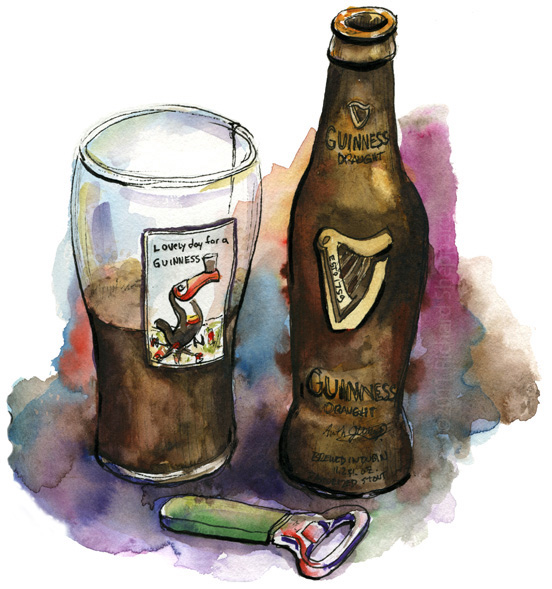
I knew my last bottle of Guinness was sadly alone in the fridge. How would it react to the news? Not wanting to disappoint, I decided to use the chipped glass one last time. I popped open the bottle and poured it into the glass. After enjoying a sip of creamy foam, I pulled out my watercolors and immortalized the glass in my sketchbook while my Extra Cold Guinness melted to room temperature. Okay, I admit it. I sipped my subject as I painted. But the beer was warm by the time I got to the bottom.

Drinking a glass of Guinness always brings me back to Dick Mack’s pub in Ireland were I heard the best session music ever. Outside the pub there is a sign that reads: “Where’s Dick Mack’s? Opposite the church. Where’s the church? Opposite Dick Mack’s.”

Camping at Stillwater Cove


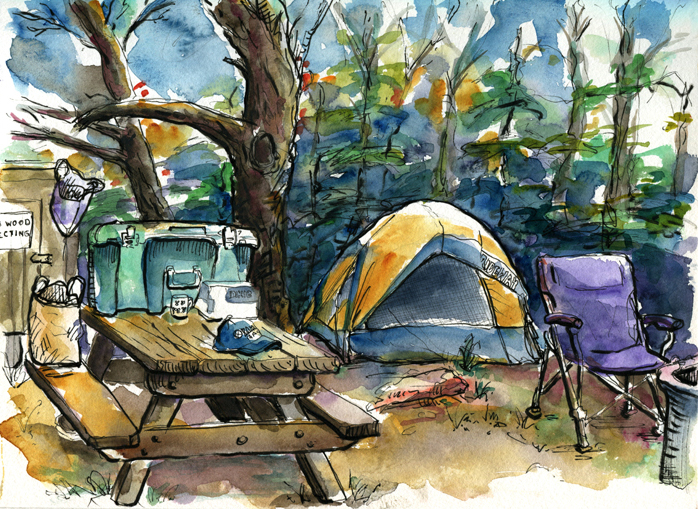
My wife and I hadn’t gone camping in thirteen years but last weekend, with the accompaniment of our good friends Jennifer and Matthew, we decided to give it a go. We drove west from Healdsburg to highway 1 and then north, up the rocky Northern California coast until we reached our campsite at Stillwater Cove. The campground was nestled among ancient redwood trees and was close enough to the beach that we could hear the ocean breeze whistle in the treetops.

After popping our tents and removing the coolers from our car, we went on a hike. We walked along well groomed trails, the redwoods towering above us created an almost cave like experience. After crossing a couple of old wooden bridges, we followed a creek, populated with ferns and wildflowers until it opened up at Stillwater Cove. Two Rubber boats lay beached on the sand like sea otters with their black rubber skin glistening in the afternoon sun. Several divers removed abalone from the boats and started to pack up their gear.

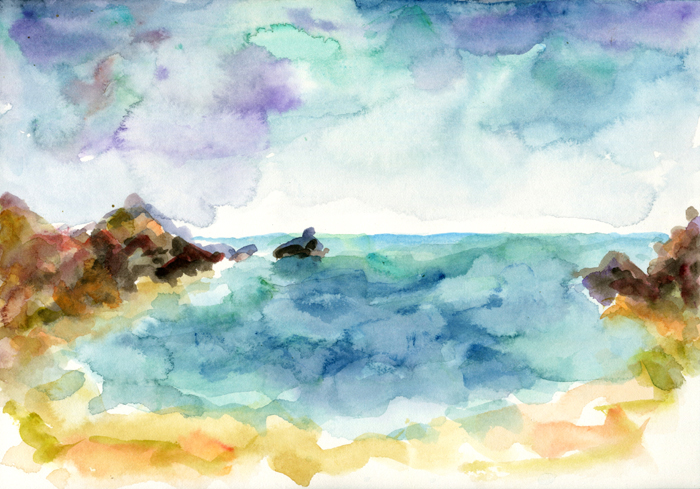
We sat on the beach for a while, taking in the ocean view. Several pelicans flew overhead and then scooped close to the ocean looking for fish. I pulled out my watercolors and with the bright sun in my face, attempted to capture the delicate colors of the windblown landscape while the others napped in the afternoon sun.

After heading back to camp, we nibbled on Humboldt Fog goat cheese, kalamata olives and slices of juicy peaches while preparing a dinner of Greek tomato salad and grilled chicken and vegetable kabobs. Lagunitas IPA Beers were passed around and with a blazing campfire to keep us warm, we skewered some marshmallows and made the obligatory, but tasty, s’mores (s’mores are toasted marshmallows and warm chocolate smooshed between two graham crackers).

As night fell, we sat in a semi circle around the fire and told ghost stories until my wife started getting the creeps and told us to stop. She then threw a napkin into the fire and I watched as the flames consumed it. The remaining charred paper lifted, with the help from the heat of the flame, and drifted like a spirit into the darkness.


Windsor Hot Air Balloon Classic

My alarm was set for 3:45 am for the Windsor Hot Air Balloon Classic, but I awoke on my own, one hour earlier, bright eyed and ready to go. After making a cup of coffee and gathering my art supplies to paint while there, I was out the door. I wanted to arrive for Dawn Patrol, which begins promptly at 5:00. At that time, the balloons are lit up like lanterns as they ascend into the morning sunrise.

As I drove down the freeway, I was glad to see clear skies, a good sign that the balloons would be able to launch. At this time of year, coastal fog can unexpectedly roll in and keep the balloons grounded, but for the moment, the weather looked promising.

After entering the gates of Keiser Park, I passed through the concession tents, the aromas of coffee and grilling pancakes warming the cool morning air. It’s hard for me to resist pancakes, especially blueberry, but I told myself it would still be early enough for breakfast when I got home.

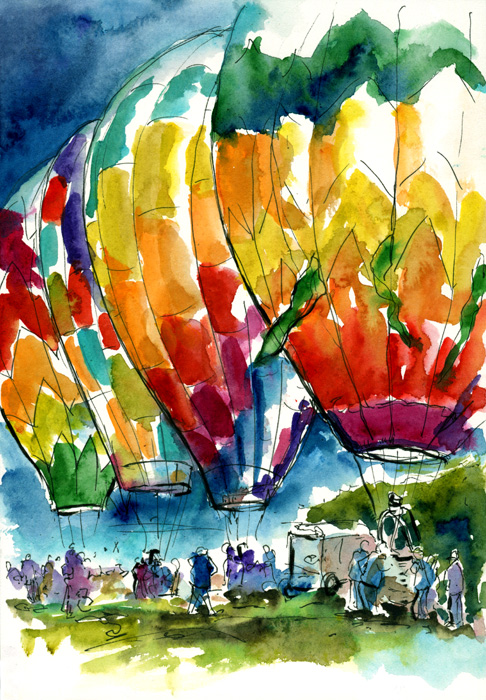
When I walked onto the field, several trucks pulled into position and with a flurry of activity, unloaded balloons from trailers, unravelling them across the grass. Compressors then filled the balloons until they rose up like sleeping giants. With four balloons now standing side by side, Dawn Patrol began, hissing flames lighting the brightly colored fabrics in a spectacular array of colors and wild applause erupted from the audience.

A couple of hours went by, as I sat on the grass painting the still grounded balloons. With the light of the day starting to creep in, several other balloons wobbled upright and into position, but unfortunately, morning fog had rolled in, canopying the area in a layer of gray. At 8:30 the announcer told the disappointed crowd that the balloons would not be able to fly. Well, there’s always tomorrow, and the weather looks more promising than it did for today.

Now, about those pancakes . . .


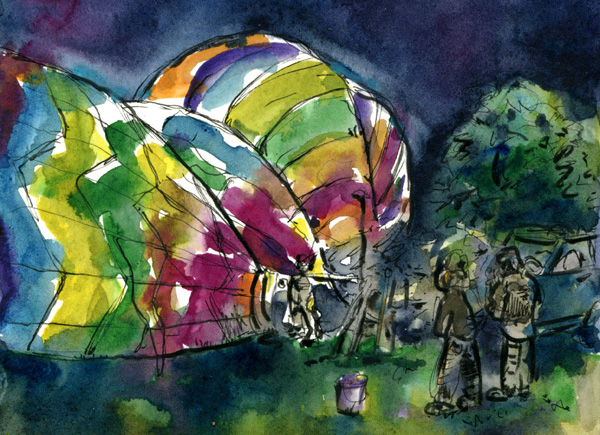
Compressors filled the balloons until they rose up like sleeping giants. I created this painting in near darkness using a small night light clipped to my drawing board. A three quarter moon from above helped light my subject.

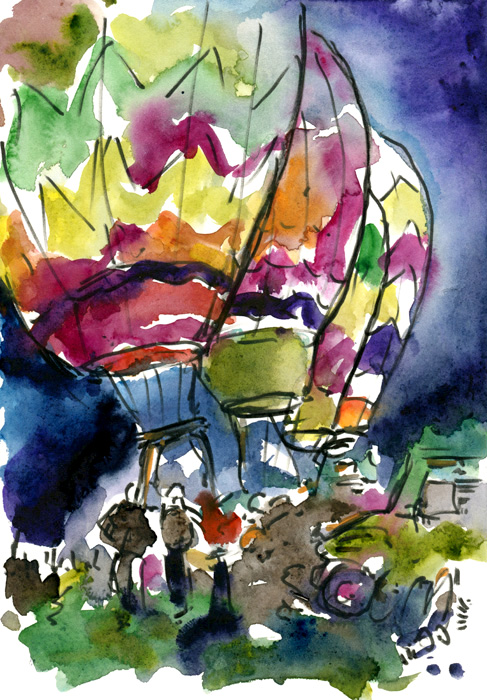
This painting was also painted in near darkness.


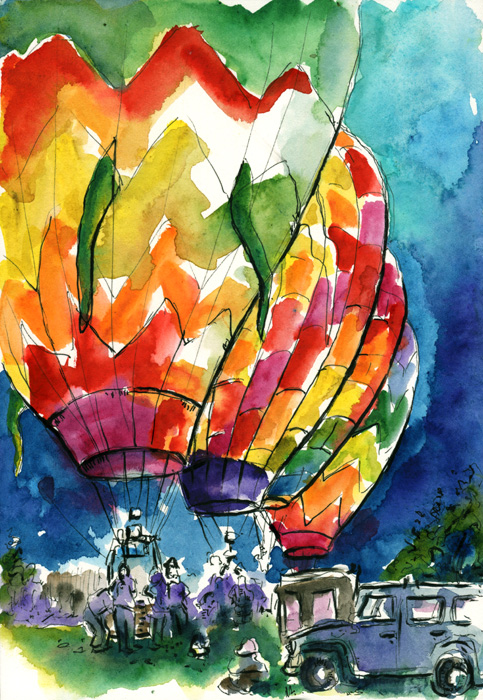
A couple of hours went by while I sat on the grass and painted the grounded balloons.

Comstock House Historic Home Tour

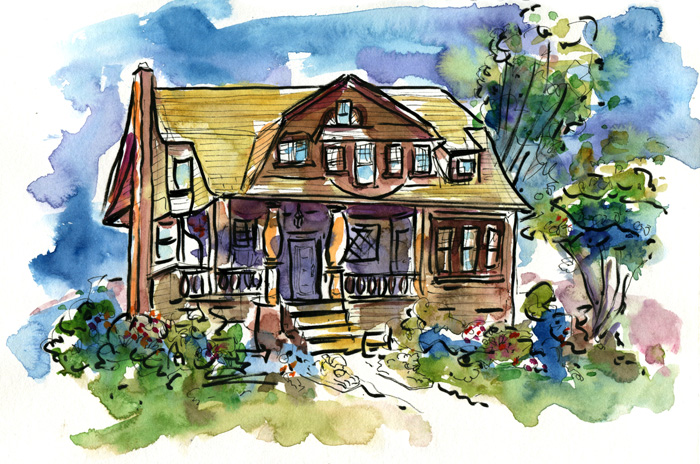
Over the weekend, I had the occasion to tour Comstock House, the historic 106 year old home of Jeff and Candice Elliott. We were a small group of artists, who were offered not only a tour but also time to sketch and paint. The house was designed by locally well known architect, Brainerd Jones, and the property is currently being restored and scheduled for completion in 2012.

As I drove past the address on a hunt for parking, it was difficult to see the house as it is mostly obscured by trees. But when I walked onto the property, I saw the Craftsman style house with its unusually asymmetrical roof and facade covered in shingles. Full-blooming dogwood trees and shrubs were scattered about and colorful flowers surrounded the porch area, guarded by two small stone lions stoically protecting the entryway.


When I entered the old house I felt time slip back a century. Redwood beams and paneling fill the house. Leaded glass decorates the windows along the staircase. Art deco chandeliers with gas candlesticks, and grape-shaped glass housing electric bulbs adorn the stairs landing. I was completely taken by the warm wooden consoles of vintage radios and TV’s scattered throughout the house. At 10 am, Jeff and Candice greeted us in the foyer and began telling stories. The open floor plan let us all gather around our two hosts to listen.

The original owner James Wyatt Oats was a murderer who fled the east coast from his crime, settling in Santa Rosa. He was later acquitted as his older brother William bribed the prosecutor who just happened to be the victim’s father. William was also a commander in the confederate army at Gettysburg. He most famously led the 15th Alabama regiment that lost the Battle of Little Round Top.

Nellie Comstock purchased the house in 1916 for $10,000 and members of her family lived there over the next 74 years. In a complete reversal from the house’s previous owners, Nellie’s father was the head of the anti-slavery group that funded famed abolitionist John Brown.

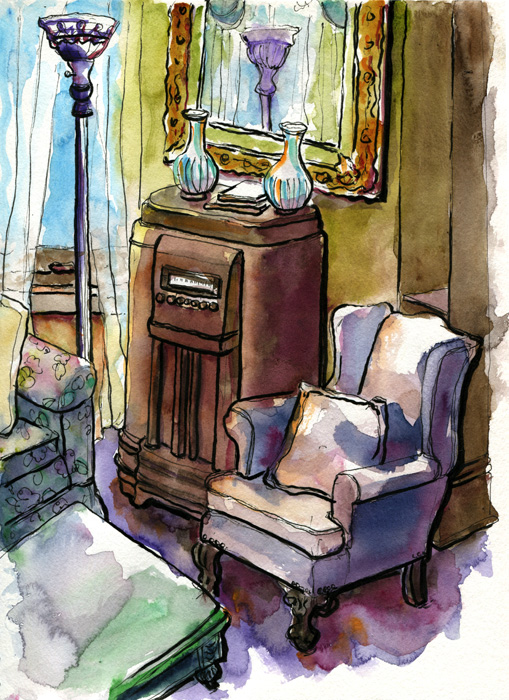
After the tour, I stood beside the piano and drew a cozy corner of the room with its vintage console radio. I just love the streamlined art deco design. While I was drawing, Jeff told me the history of the mirror hanging above the radio, which turned out to be a picture frame engraved with the artist’s name and painting title. The frame, Jeff said, is from a missing painting by the British artist J. B. Payne titled “In the Village of Cheddar”, which no one has ever heard of nor seen the original. Now there’s an important mystery to be solved!

A warm thanks goes to Jeff and Candice Elliott for the tour and allowing us to sketch and paint their delightful, historic home.


Irving Street, San Francisco

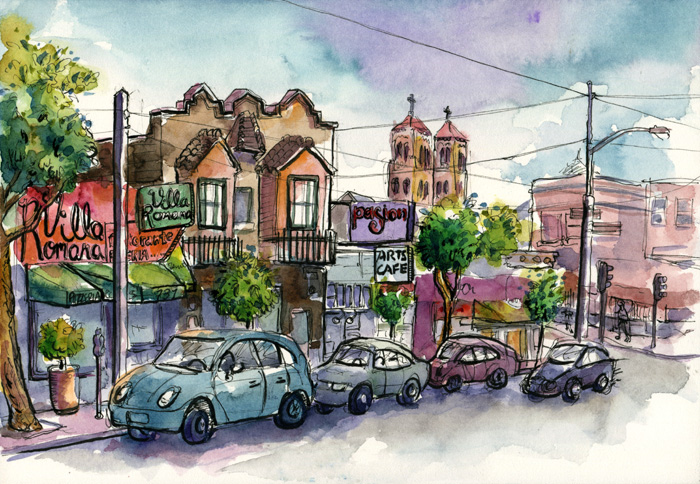
Today I took advantage of a space between jobs and headed down to San Francisco to draw. I chose the Inner Sunset location for its street cars and eclectic buildings which are great subjects to sketch. But more importantly, I lived there for almost ten years before moving to Healdsburg in 2000 so it has a nostalgic feel to it.

The damp air from the morning’s residual fog and cold, enhanced by an on-shore breeze, kept my skin at attention. Yes, it’s June, but this is San Francisco. I chose to draw Irving St. looking east towards Ninth Ave. because my wife and I had our wedding rehearsal dinner at Villa Romana Italian Restaurant. I have fond memories of that dinner with a gathering of friends and family that rarely get a chance to see one another.

But halfway through my drawing I stopped because the cold was coming right through my jacket. I decided to pack up my gear and warm up in Art’s Cafe across the street. The cafe has counter seating for about twelve along a narrow corridor. I sat myself somewhere in the middle and ordered a short stack of pancakes and coffee.

While waiting for my order to arrive, I browsed the old postcards placed beneath the glass of the counter. That’s when a postcard of the Acropolis in Athens caught my eye. I pulled out a copy of my book, “The Artist on the Road: Impressions of Greece” from my messenger bag and compared a drawing I did of the Acropolis while in Greece. Both vantage points were almost identical. How cool it is that I should sit down in this spot!

After having been warmed with good food and coffee, I grabbed my messenger bag and headed back out into the cold.