Lion Gate at Mycenae

We pay our fee at Mycenae’s entrance and are immediately confronted with the magnificent stone entryway called the Lion Gate. It was built circa 1250 BC, a few decades before the Trojan War. Mycenae at that time was the kingdom of Agamemnon, the general who led the Greek forces against Troy. He sacrificed his daughter, Iphigeneia, to the goddess Artemis to get favorable winds to sail to Troy, and when he returned home, his wife, Klytemnestra, killed him for it. While he was at his bath, she wrapped him in royal robes and struck him three times with an ax.

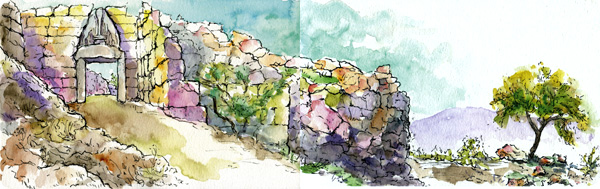
At the entrance to Mycenae, two sandstone lions stand above the gate itself. Both lions are headless now, but in antiquity they stood face to face. I position my portable chair beside the walkway. The wind has calmed enough now that I’m ready to get started. I’m choosing to paint the Lion Gate because, with its headless lions, it’s the most legendary and distinguishing aspect of the site. I’m lucky to have brought my watercolor Moleskine sketchbook because its landscape format is perfect to capture both the gate and the walls forming this extended view. In this drawing, I shorten the wall to the right, fitting the whole scene onto the page, including the cypress tree. Tightening the drawing in this way will, I hope, render it visually stronger, and with the help of the tree, balance the weight of the Lion Gate on the left.
Mycenae’s Ancient Ruins

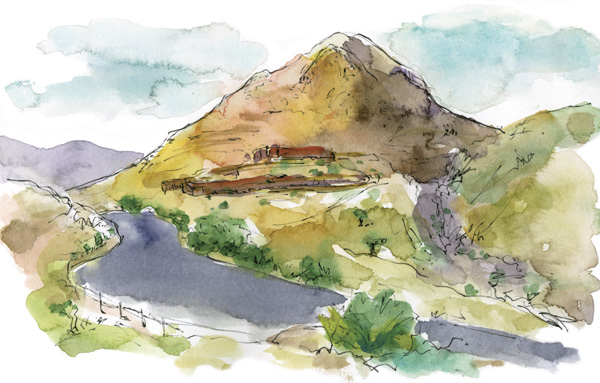
Standing outside Mycenae’s ancient ruins, hands in our pockets and our backs to the wind, we wait for the gate to open. The sky is clear this morning, but I fear the weather might be a nuisance while painting. I’m still tired too. Last night around midnight, a motorcycle raced up and down the street in front of the hotel, blaring its exhaust until I thought the sound would blow out the windows of the hotel. Then a car joined in the fun, and together they raced up and down the otherwise deserted and tranquil street. I was too tired to get up and look out into the darkness, and eventually, once the clatter stopped, I fell back asleep.

The Mysteries of Eleusis

Excerpt from my book “The Artist on the Road”:

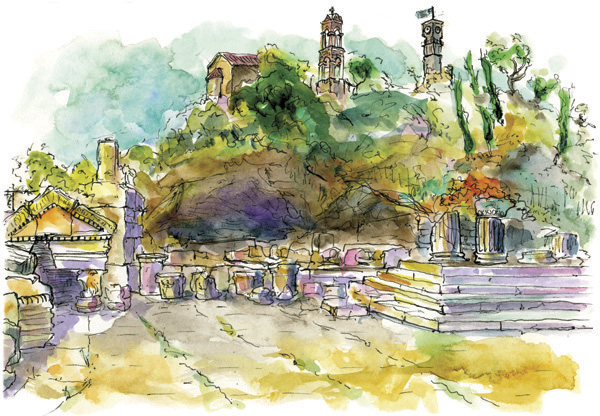
…we finally make our way to Eleusis, but it will close earlier than we expected, at 3 pm, so we only have an hour and a half. Scouring the site by foot, I’m having difficultly finding a good subject to draw. Overall, the site isn’t a bad place to sketch, but there isn’t a tall structure like a temple for example, to compose a picture around. Most of the site contains ruins only a couple of feet high. I’m beginning to think Athens spoiled me. Finally, I choose a place near the entrance. At this angle, I have architectural ruins in the foreground with the entrance to the Underworld, a grotto, in the background.

While I start blocking in the larger shapes on my paper, my dad checks in, and reminds me of the mythology of Eleusis. It was here in primordial time that Hades sprang from the ground in his horse-drawn carriage to kidnap Persephone, the daughter of divine Demeter, taking her through the Gates of Hades (the grotto) and into to the Underworld to serve as its Mistress. Eleusis was also the site of the ancient Mysteries, during which Demeter’s search for her kidnaped daughter was reenacted. Every fall at this time of year, as many as a thousand people from all over the ancient world were initiated into the Mysteries. During the ceremony, the initiates witnessed an epiphany exposed by a blinding flash of light. The essence of the epiphany was kept secret under punishment of death, and even today remains unknown. Once initiated, and later reaching the end of their mortal lives, they passed into the Elysian Fields, where they lived out eternity in Persephone’s care and in the presence of the gods.

Just before I finish my painting, a guard tells us that the site is closing in a few minutes. What a quick hour and a half. I have just enough time to gather my belongings and drag them outside the gate. Once there, I put the finishing touches on my painting, and use a cardboard folder as a fan to hasten the drying time. Luckily, I’m traveling with two watercolor blocks so that while one painting is drying, I can start a new one. If I could only find the time to paint two paintings instead of one at each location, I’d be doing great. But today is not that day since we are already back on the road and headed to our next destination, Mycenae.

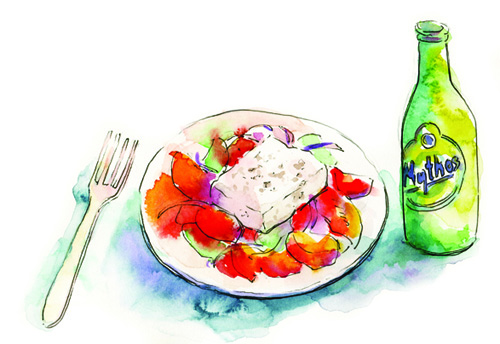
Greek Salata and a Mythos Beer

Our first evening in Athens, we settled into an outdoor cafe for an early dinner. I ordered an open faced gyro, starting with a Greek salata: ripe tomatoes, tangy vinaigrette, red onions, kalamata olives, and a slab of seasoned feta. While I was enjoying my salad, a little girl, maybe eight-years old, approached us from the street carrying an accordion. She played a single note on the instrument and said in English, “Money please.” When we shook our heads no, she turned, without a blink of an eye or expression of disappointment, to the next table and repeated. It was very amusing.

Hand Painted Moleskine Sketchbook

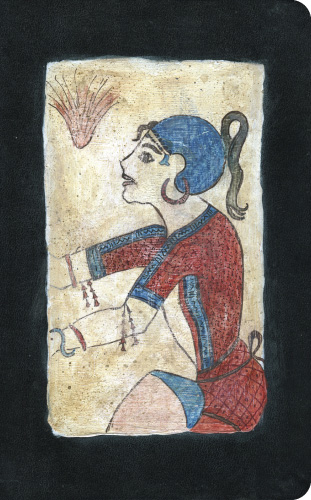
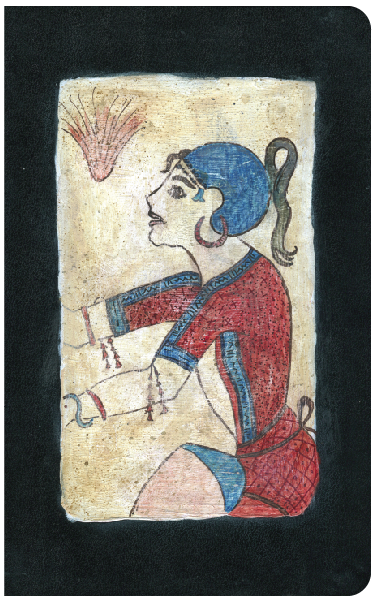
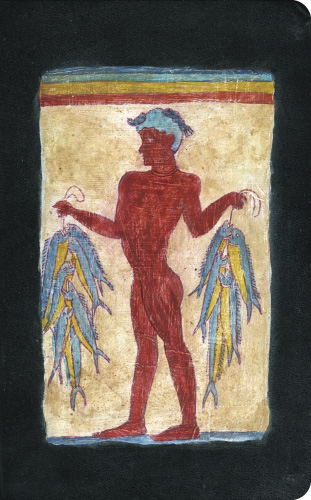
I painted this Moleskine sketchbook cover using an image from an Akrotiri wall painting. Akrotiri was an ancient city on the island of Santorini in Greece, and was destroyed when the volcano (upon which it was located) erupted circa 1,600 BC. The wall paintings uncovered by archeologists have an amazing modern quality about them. I find their sense of design and beauty similar in many ways to today’s artistic sensibilities. The painted subjects are outlined, and the resulting faceted shapes are filled with flat washes of color. Although this type of graphic style is more symbolic than naturalistic, a crocus is obviously a crocus, and a goat is definitely a goat. The figures represented in the wall paintings also have this same flat, graphic style but they have an extra level of detail with decorative patterns painted across their clothing. One of my personal favorites is a beautiful girl out gathering saffron from crocuses in her beaded, Minoan costume, a flounced kilt tied at her waist. It’s ironic that the event that destroyed this ancient civilization saved the wall paintings for posterity. If the Thera volcano had not erupted 3,600 years ago, preserving the frescos in volcanic ash, we would not have representations of this civilization today.

How (and Why) I Paint my Moleskine Sketchbook Covers

After spending months drawing in my sketchbook, I’m a bit reluctant to finish the last page. The completed book is filled with places I’ve traveled, friends I’ve met, and delicious food I’ve eaten, all wrapped up in memories. But starting a new sketchbook is exciting too. I often think about the places I’ll visit and the people I’ll meet while drawing within its pages. If I’m lucky, I’ll discover a new drawing or painting technique that I’ve never tried before. Although the pure enjoyment of drawing is my main purpose for sketchbooking, I intend to improve my drawing abilities along the way.

I used to draw in Moleskine sketchbooks but now I make my own. Either way, the technique for painting the cover is the same.

  1. For the base, I paint gesso on the front of the book in a loosely painted rectangular shape, then let it dry. I repeat this two more times, lightly with sandpaper between applications to remove the bumps and brush strokes. Sometimes I add a small dab of color to the gesso to soften its brightness.
  2. Then, using a dampened paper towel, I rub a small amount of earthy acrylic colors on top of the base to provide visual texture and depth.
  3. Next, I sketch my subject on the cover in pencil and then draw over my pencil lines in permanent ink. If I make a mistake, I can use sandpaper to remove the offending line and then rub more color into the resulting white area.
  4. Once my drawing is complete, I paint the resulting shapes with color. Sometimes, for texture, I spatter watered down acrylic paint over the finished piece with a toothbrush to add depth and texture. After letting the cover dry overnight, I’m ready for my next great sketching adventure.

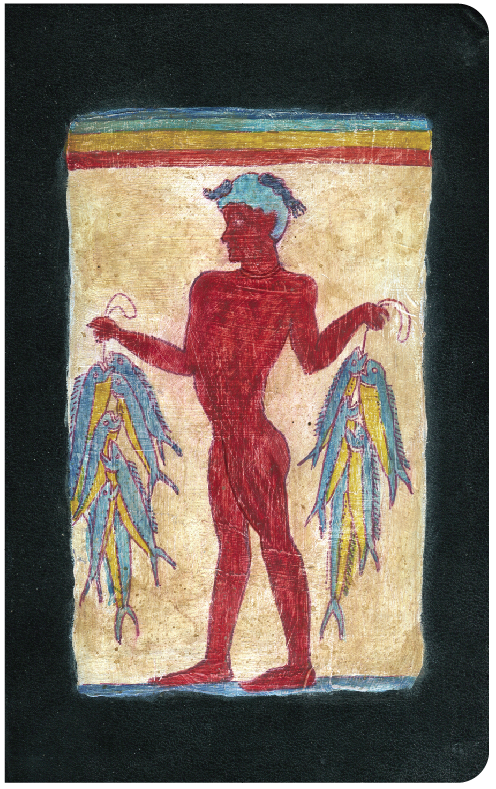
These two sketchbook covers were drawn from photos of the archeological wall paintings of Akrotiri on the island of Santorini, Greece. The original wallpaintings are thousands of years old.

Hand Painted Moleskine Sketchbook Cover

I hand paint my Moleskine sketchbook covers in acrylic to personalize each one. This is one of two sketchbooks I painted and used while in Greece last October. The cover painting is a copy of an Akrotiri wall painting from the archeological site on the island of Santorini. The Minoan civilization that created the wall painting flourished over 3,600 years ago.

Watercolor of My Travel Bags

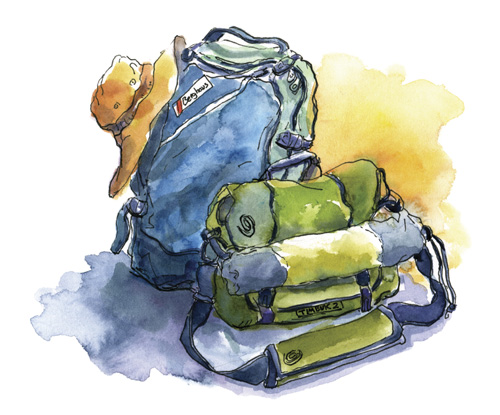
This is a painting of my backpack and messenger bag (containing all my art supplies) that I used while traveling in Greece. I bought the backpack many years ago when I lived in London and I still use it regularly. The messenger bag was a recent purchase for this Greece trip and it worked out well. The brand is Timbuku. It has lots of internal compartments to separate my supplies and overall construction seems sturdy. I only have two complaints about this bag. One, the trim on the flap tends to stick to the velco and fray. The second problem is the two water bottle holders on the sides don’t hold my water bottles very well. A good art supply bag is hard to come by these days because most of them are so poorly made. Overall, I would recommend the Timbuku bag. My wide brim hat comes in handy when the place I choose to draw doesn’t come with a shade tree.